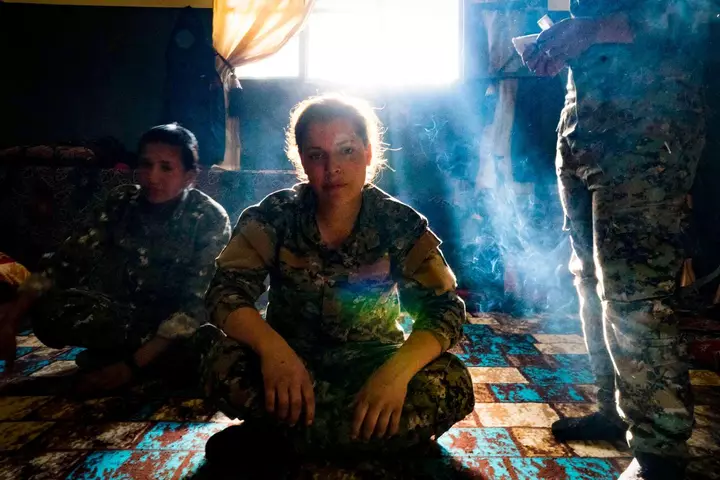
In Rojava, a formerly autonomous region in northeastern Syria, August 2017. Photo by Jade Sacker/NurPhoto/Getty Images When I was seven years old, my family was forced to flee escalating violence. We left Bakur – a Kurdish region in what is currently southeastern Turkey – for a city further west, where we worked in Turkish fields, living in a tent until we could save up to rent a house on the city margins, in a neighbourhood with no electricity or road access.
Those are some of my earliest memories of everyday violence against people like me. For centuries, my ancestors had lived in relative harmony with other communities. But, with the emergence of modern nation-states in the region, Kurdistan – the traditional homeland of the Kurds – was fractured into southeastern Turkey, northern Iraq, northwestern Iran, and northeastern Syria.
A violent assimilation was imposed upon us. For more than a century, Kurdish people have been denied recognition as a nation, their language banned, erased from maps, stripped of citizenship rights, and dispossessed of their lands. For my generation, therefore, freedom was never an abstract political matter; armed struggle was often seen as a necessity to achieve it.
Even so, national liberation movements always sought dialogue with the states they fought against. I grew up inside that insistence, carrying the hope of a dignified peace. In 2013, after almost three decades of war, peace talks were held between the Turkish state and the Kurdistan Workers’ Party (PKK), which first sought an independent Kurdish state and, later, autonomy and increased political and cultural rights for Kurds within Turkey.
In 2015, these collapsed. War returned to Kurdistan and, with it, the persecution of everyone who had staked something on that possibility of peace. I was a doctoral student at the time, researching economic autonomy in Kurdistan, and it became clear that this work would no longer be tenable in the new political climate.
I moved to Latin America, to complete my doctoral studies and study revolutionary movements in that part of the world, grappling all the while with a question that had become inseparable from my own existence: how could peace be built in Kurdistan? The academic literature on peace told me I might find an answer in Guatemala. Between 1960 and 1996, civil war had ravaged the country, killing more than 200,000 people and displacing more than a million – more than a 10th of the total population.
Extract — continue reading at the source.