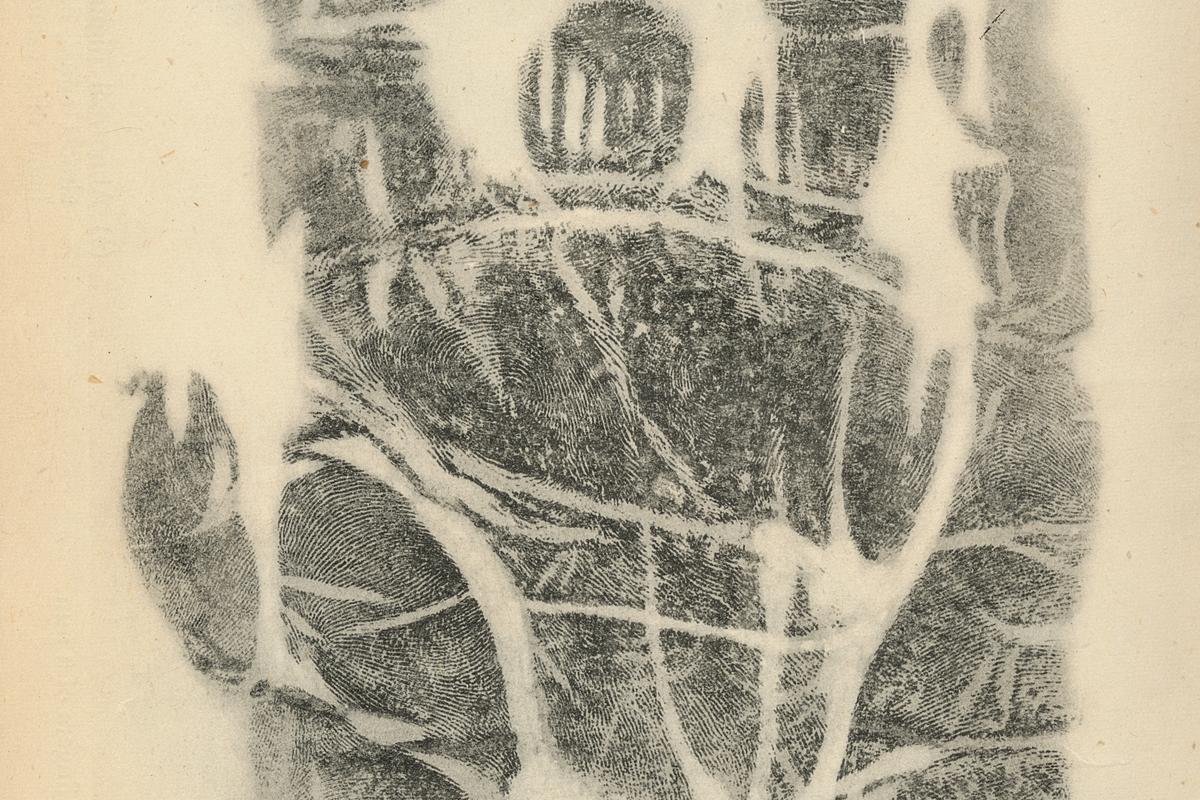
Detail from Mok the lowland gorilla’s handprint, collected after his death, reprinted in The Human Hand (1942) by Charlotte Wolff. Image supplied by the author and courtesy the Wellcome Collection, London Signs of the future are marked in our hands, or so any palmist will declare. But do hands also hold signs of the past?
Over decades of research as a historian of medicine and of human bodies, I’d never imagined such a niche question. And then it was sparked in an instant, between one second and the next, in the time it takes to open a manila folder. For another project altogether I was in the UK to research the papers of Charlotte Wolff, a physician trained in Berlin in the 1920s and living in London in the late 1930s, a Jewish refugee.
Opening a file labelled ‘Zoo, 1938’, I came across a massive, delicate palm print: it belonged to Mok, a lowland gorilla at London Zoo. Two days after Mok’s death, the keeper had granted Wolff special permission to enter the morgue and collect a pattern that had been too dangerous to acquire in life. Mok’s palm print was both forceful and touching.
Indeed, I was tempted to literally touch, to hold hands across time, across species, and across the worlds of the living and the dead. The emotive power was unmistakeable, yet for all my training as a historian, it was inscrutable to me. I was also puzzled why Wolff, an exceptionally clever physician, seemed to be practising palm-reading, which today is associated with magic and the occult.
Could there be such a thing as medical palmistry? Over time, I learned that the answer is a clear, but unlikely, ‘yes’. Wolff was looking for the so-called ‘simian line’, a particular crease that some humans share with other primate species.
Long ago, in embryonic time, the patterns on each of our tiny, clenched palms were formed. For most of us, three main lines were created. For some of us – up to 5 per cent – the so-called head and heart lines fused into a single crease stretching across the palm from one side to the other.
Extract — continue reading at the source.