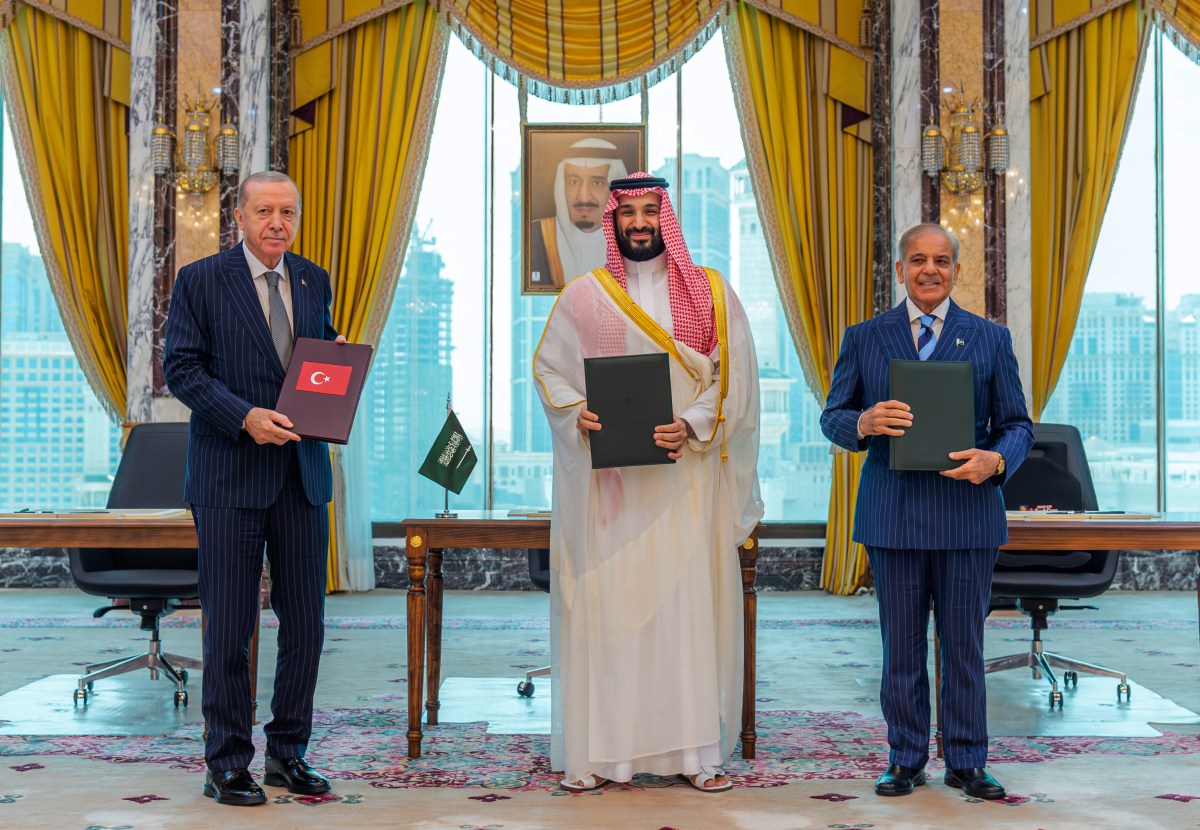
In April 1949, representatives of 12 countries met in Washington, D.C., to sign the treaty that birthed NATO. It took more than 50 years and the turn of a new millennium for one of its founding members to sustain an attack deemed fit to trigger the all-important Article 5, forcing the alliance to deliver on its collective security promise. Saudi Arabia, Turkey and Pakistan signed the Mecca Joint Defense Agreement on August 7, 2026.
Thirty-two days later, ballistic missiles and drones began raining down on one of its members. Yemen’s Houthi rebels this week struck civilian and economic targets in the Saudi cities of Abha, Khamis Mushait, Jazan and Najran, injuring more than 70 people, including women and children. The group declared its ballistic missiles were aimed at facilities of Saudi national oil company Aramco, a key industrial hub, and the Saudi Air Force’s King Khalid Air Base.
With the world watching, will the fledgling defense alliance rise to the challenge? Calling the Mecca agreement a Muslim or Middle Eastern NATO isn’t a loose comparison drawn by ill-informed Westerners unable or unwilling to see the world from any perspective other than their own. The official joint statement heralding the agreement said its signatories wanted to strengthen "collective deterrence against any act of aggression," stipulating that “an armed attack against any one of the three States shall be regarded as an attack against them all." Pakistan stressed each signatory’s right to collective self-defense under Article 51 of the United Nations Charter.
Turkish Foreign Minister Hakan Fidan said the core provision of the defense agreement was “technically the same” as NATO’s Article 5. Less than a month after the agreement was signed in Islam’s holiest city, the foreign ministers, defense ministers and military chiefs of all three parties met in Istanbul for the first Strategic Political and Defence Committee. There, they agreed to create a permanent secretariat in Saudi Arabia, initially headed by a Pakistani secretary-general - steps intended to ensure the "credibility and effectiveness" of their collective deterrence and defense.
Eight days later, Houthi missiles and drones slammed into Saudi territory. This prompted a flurry of strongly worded statements. Ankara condemned the Houthi attacks "in the strongest terms," backed Saudi sovereignty and territorial integrity and called on the Yemeni rebel group to cease its attacks immediately.
Pakistani Prime Minister Shehbaz Sharif called the strikes "cowardly" and promised "unwavering solidarity," while his defense minister, Khawaja Asif, reiterated that “any aggression against any of the three is regarded as an aggression against all.” But hot air is all Saudi Arabia’s new partners have offered so far. We’re more than a day removed from the attacks, and at the time of writing, not a single Pakistani fighter jet or Turkish drone has threatened to breach Houthi skies. We can’t dismiss the Mecca agreement as a paper tiger just yet, though.
Extract — continue reading at the source.