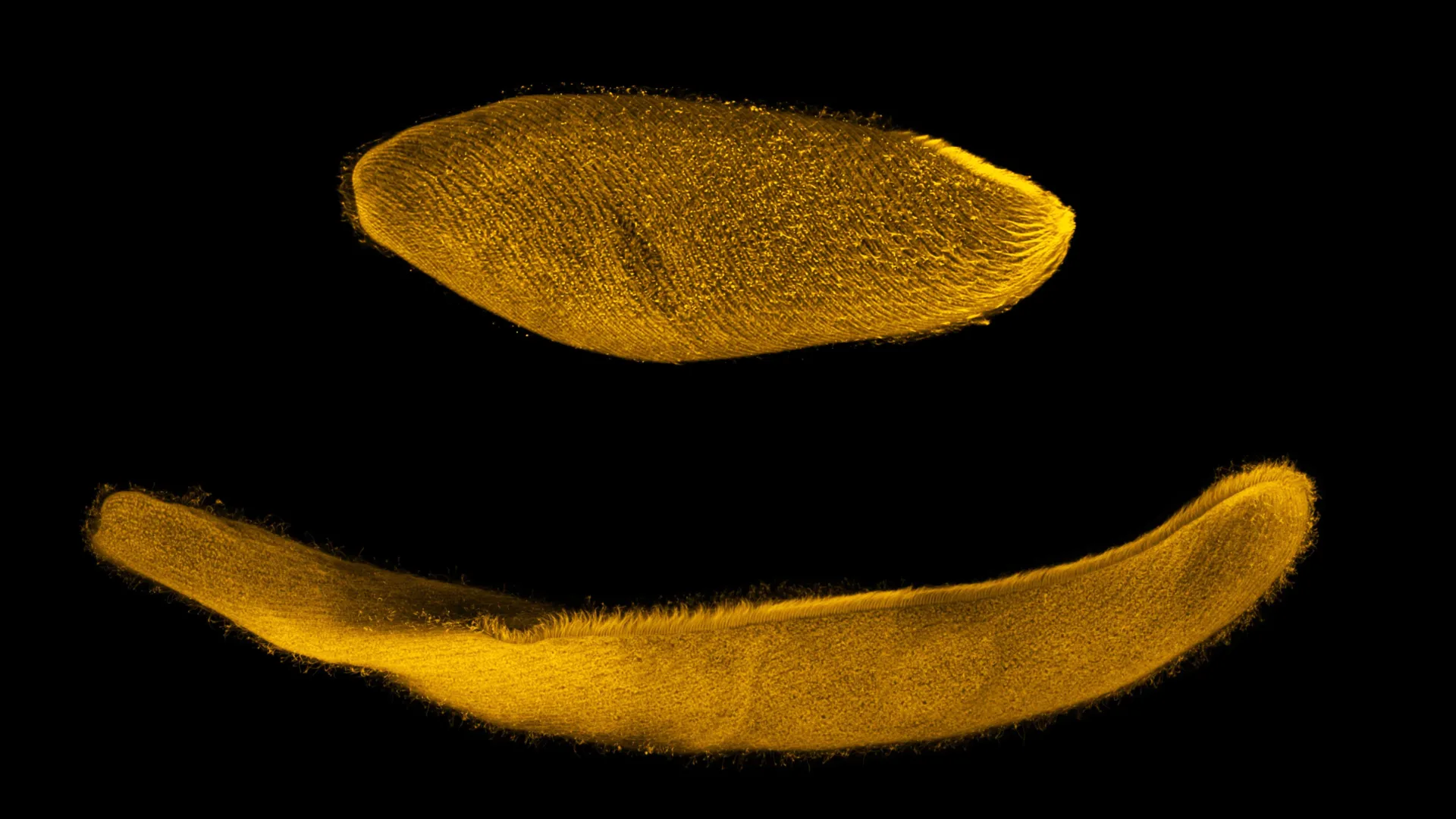
A tiny aquatic organism made of just one cell can compress its body to one quarter of its original length in under five milliseconds, hundreds of times faster than a person can blink. Scientists have now identified the unusual mechanism behind this remarkable movement. The organism, Spirostomum ambiguum, relies on calcium ions and a specialized protein network arranged like a fishnet.
This system allows it to contract far more quickly than human muscle, and researchers say the discovery could eventually help guide the development of faster artificial muscles and synthetic cellular machinery. Spirostomum ambiguum is a giant single-celled ciliate, named for the fringe of hairlike cilia it uses to swim. Among ciliates, it stands out for its ability to contract at roughly 100 body lengths per second and then rapidly repeat the movement.
Scientists think this behavior may help the organism escape predators or communicate with other ciliates. Human muscle fibers can shorten by comparable proportions, but the process takes about 10 times longer. That difference has made Spirostomum especially interesting to researchers who want to understand the machinery that makes its extreme speed possible.
"The difference between what Spirostomum can do and what we can do comes down to what is powering the contraction, and what the machinery behind it looks like," says Mary Elting, associate professor of biophysics at North Carolina State University and co-corresponding author of the work. "If we can understand those processes, it could help us build synthetic systems that mimic the speed and power of this single-celled organism." A Protein Network That Works Like a Fishnet Using electron and immunofluorescence microscopy, the research team examined Spirostomum in detail. They found that calcium ions initiate the contraction, while an unusual fishnet-like structure carries out the movement.
Unlike animals, single-celled organisms such as Spirostomum do not have muscle fibers. Instead, they contain fibrous structures called myonemes. These structures are made from the calcium-binding proteins centrin and Sfi1.
In Spirostomum, the myonemes form a fishnet-shaped web around the outside of the organism. Once contraction begins, this network tightens inward and then returns to its original configuration. "The fishnet geometry is unique because it lets Spirostomum contract uniformly, which protects is internal organelles (single cells' versions of organs) while it moves so quickly," Elting says.
Extract — continue reading at the source.