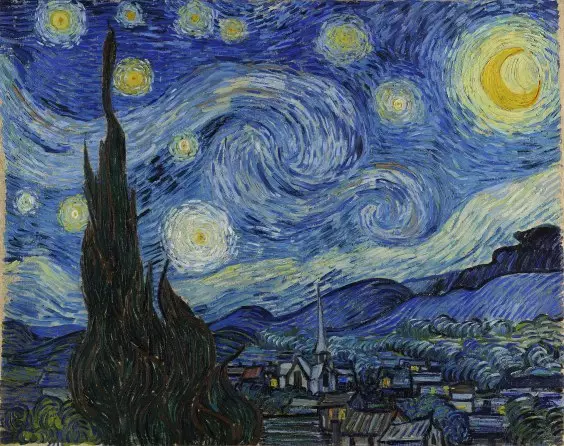
While Starry Night is the traditional shorthand for Vincent van Gogh’s most famous work, its actual title is The Starry Night. It’s a more fitting name for such an iconic work, but does the painting depict an actual starry night, or did it spring from van Gogh’s vivid imagination? Art historians have debated the question for decades, but now astronomers are getting in on the action with a new study published in Scientific Reports.
By taking a multidisciplinary approach that involves observational geometry, historical weather records, and even cicadas, they think they’ve nailed down the actual date of The Starry Night in question. Read more: “This Image from the Dark Energy Camera Is a Bit Van Gogh, No?” Originally, van Gogh’s work was thought to be just an artistic representation of a night sky. But when researchers surfaced a letter written by the painter mentioning Venus, some acknowledged that at least one of the painting’s swirly glowing orbs was inspired by a real celestial body. (You can see it just above the horizon, to the right of the cypress tree’s branch.) In the 1980s, researchers started taking the painting seriously as an astronomical text.
Using the position of the Venus orb as a lodestar and matching it to planetarium reconstructions of the night sky, art historian Albert Boime determined that three stars corresponded to the constellation Aries as it was visible from the location on June 19, 1889. The date came from letters van Gogh had sent to his brother, along with sketches of the work, detailing the painting. There was one glaring problem with Boime’s analysis—the moon was all wrong.
Looking out from the window of his asylum in late June, van Gogh would have seen a waning gibbous, not the slivered crescent he painted. This discrepancy, to Boime, was van Gogh taking a bit of artistic license. According to the historian, the glowing lunar penumbra and apparent paint scraped from the concave surface of the crescent indicate van Gogh may have painted the fuller gibbous, then changed his mind.
But per this new study, Biome’s analysis is incorrect, and the clue was the constellation he identified in the work. According to the team, van Gogh painted the pre-dawn sky of July 22, 1889. On that night, the Hyades (which form a V shape) would have been visible alongside Venus near the horizon and a crescent moon.
In fact, the team’s shape analysis confirmed the correspondence between five central stars of The Starry Night and the Hyades, and proved to be an even better match with a sketch van Gogh made after completing the painting. So all the stars seemed to be aligned for a late July completion, but the team ran into another problem. Most scholars agree van Gogh suffered a seizure around mid-July that left him unable to paint for some time.
Extract — continue reading at the source.