It’s not the austere, black Thames winding through London, where I was born, but a lazy green one 5,000 miles away, where I spent my adolescence: the Blanco River in Texas. My maternal ancestors have dipped into its waters for generations, as I have on countless summer days. The Blanco is a tributary of the San Marcos, which flows into the Guadalupe, and on into the Gulf of Mexico.
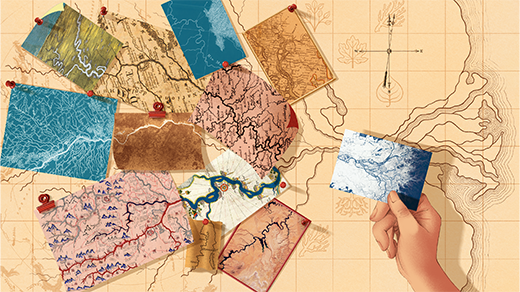
You can probably picture how this looks on a map because all river networks look similar, creeping through the landscape, merging into ever wider and longer channels, downhill to the sea. The pattern resembles twigs on branches that connect to trunks of trees (and the branching of their root systems, too), and it likewise resembles the veins of plant leaves, our own systems of blood vessels, and train and highway networks that feed into cities. There’s something appealing about this ubiquitous pattern, so appealing to me personally that I have it tattooed on my forearm: the silhouette of a tree, with leafless branches reaching upward and roots burrowing downward, almost in mirror image.
Systems that branch in this way are “transport networks”: They transport some fluid substance (water, blood, traffic) from every place to a single place (the sea, a heart, a city center). Of the various examples, rivers are especially revealing, I think, since they arise from neither biological evolution nor urban planning, but rather chaotic Earth processes. Yet they obey simple, universal laws.
A discovery about river networks in 2026 reignited my curiosity about their universal form and mathematical nature. These were hot topics in the 1980s and ’90s, when rivers were studied as natural examples of “fractals”: mathematical objects whose features repeat in roughly similar forms at many different scales. Geomorphologists, who specialize in the shape (and continual reshaping) of Earth’s surface, have studied the geometry of river networks far longer, since the late 1800s.
Though many details of river behavior are still being actively studied, the existing mountain of research has yielded explanations that add up to a somewhat satisfying basic understanding. The math is elegant, the geophysics is intuitive, and still my sense of wonder is undiminished. Every square inch of land on Earth’s surface receives precipitation, and much of it drains out, eventually, to an ocean or lake.
Rivers are the drainage system. Geological Survey scientist named John Hack discovered the most important law of river networks. In rivers and streams in Virginia and Maryland, Hack measured the length of each stream and the area of the land that slopes toward that stream and therefore drains into it, called its basin or drainage area.
Extract — continue reading at the source.