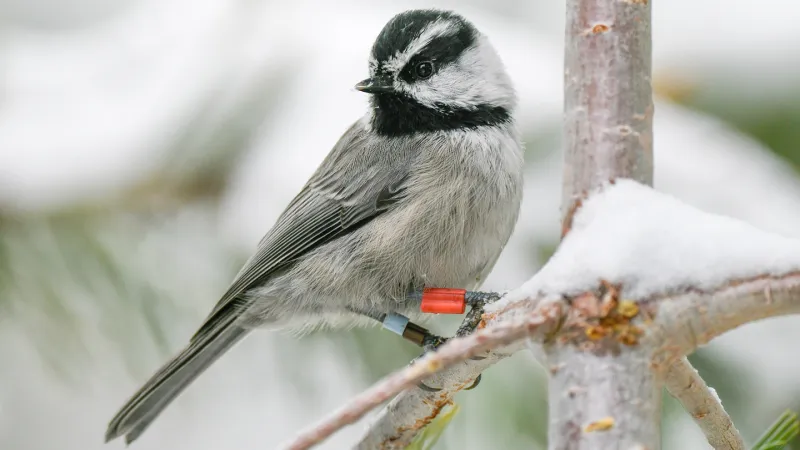
A mountain chickadee waking up in the Sierra Nevada range on a snowy morning has no time to dawdle. Weighing about as much as a pencil, it needs to find stashed pine nuts within minutes or succumb to the howling winds and subzero temperatures. But fortunately, these tiny songbirds are master memorizers, says behavioral ecologist Ai Ana Richmond.
A given chickadee knows exactly where it hid each of the hundred thousand seeds it stored for winter. Richmond, of the University of Nevada, Reno, and her UNR colleagues trek year-round to the Sierras to study this remarkable ability — by snowmobile when necessary. Much work looking at animal cognition is done in the lab.
But the site where this team is working — Sagehen Creek Field Station, about 16 kilometers north of Truckee, Calif. — hosts one of the longest running studies of animal cognition in the wild. Automated technology operating there annually tests the memory of up to 250 birds. These and other long-term data are revealing the role of memory in survival, reproduction and other life history traits, insights that are difficult and often impossible to get in a lab.
The need to be — and stay — smart affects every aspect of the birds’ lives. Vladimir Pravosudov, a behavioral ecologist at UNR, founded the chickadee study to get a more realistic understanding of why animals need good memories. His interest in avian cognition dates to his days as an undergraduate in Russia, where he studied seed storing in tits that live above the Arctic Circle.
He started working with mountain chickadees (Poecili gambeli) in 1999. Called a’ni ki in the Shoshone Indigenous Goshiute dialect, these birds ferret out single-seed stashes from tree crevices “in brutal conditions,” often with more than four meters of snow on the ground, Richmond says. About two-thirds never make it through their first winter, the team’s work showed.
Those that do can survive a decade or more. The smartest live the longest, the researchers reported in Science in 2024. Now the team is studying the consequences of such long lives.
Extract — continue reading at the source.


/https://tf-cmsv2-smithsonianmag-media.s3.amazonaws.com/filer_public/a6/10/a6103184-b809-42ab-879e-eee064986397/h_h_holmes_castle.jpg)