The icon indicates free access to the linked research on JSTOR. For over a century, the physical phone book could be found everywhere, yet seemingly belonged nowhere: a book without a genre, at once mundane and mysterious, raising questions that vexed courts and corporations alike. In print, it’s all but vanished, though it lingers in the names of the websites and search engines that replaced it, the data they were built from, and the way we’ve learned to interact with information.
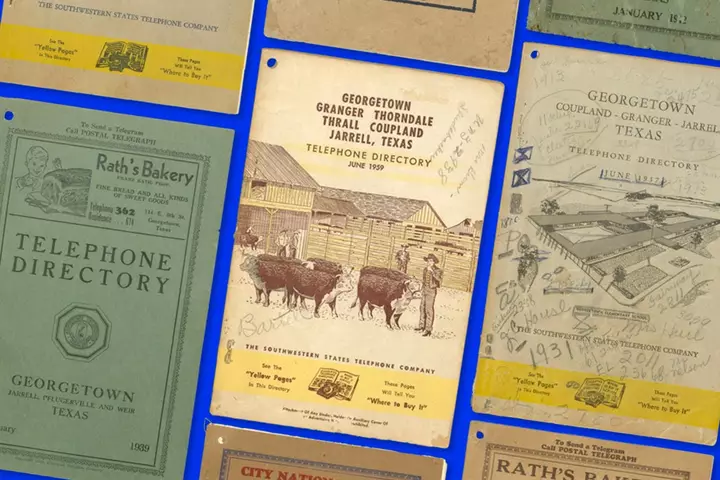
Southwestern University’s collection of Georgetown, Texas directories—eighteen volumes spanning 1913 to 1959—charts the evolution of the phone book in fine print and shows how it helped shape a vision of something new: networks people could not merely connect to, but could also ask things of. The phone book is nearly as old as the phone itself. The telephone was born out of a mid-1870s race to improve upon the telegraph, which required trained operators at both ends and dedicated wires between them, and still wasn’t fast enough for an increasingly global market.
The directory followed soon after to encourage its adoption and use. In retrospect, the competition to top the telegraph ended on February 14, 1876, when two men filed competing U.S. patent claims for a method of transmitting speech electrically. Courts would eventually set the course of the American telecommunications industry by naming Alexander Graham Bell the sole inventor of the telephone and his Bell Company the sole holder of rights to electronically transmitted speech.
At the time, though, there was real doubt about the business value of the so-called “talking telegraph”—enough that when Bell offered Western Union his patent, the telegraph company declined. The refusal reflected the verdict of the “practical telegraph men,” which Elisha Gray—the loser of the patent battle—put plainly: “In a business light it is of no importance. We can do more . . . with a wire now than with that method.
And speed is the only thing we are after.” The cover of the 1913 Georgetown directory announces two telephone companies in one book, each operating under its own rules. It also carries a badge declaring both as independent—a distinction that had been impossible until Bell’s patents lapsed, twenty years before. The public, too, “had to be educated,” as the Bell Company itself put it, “to the necessity and advantage of the telephone.” Advertising could turn people into customers, but helping phone owners form what Bell called a “telephone habit” required a different tool.
A 1941 article in the _Bulletin of the Business Historical Society_,“Business and the Telephone, 1878: As Illustrated by Early Directories,” links the telephone’s rapid adoption by businessmen to the equally speedy evolution of its instructive paper counterpart. Printed in New Haven in February 1878, the first phone book was not a book at all but a single page, with fifty-odd names listed in no discernible order. Boston and New York issued improved versions over the following months, with added attention to organization.
Extract — continue reading at the source.