The history of the printed word is full of bibliographic twists and turns, major historical moments, and the significant printing of books now so obscure no one has read them since their publication. Most of us have only the sketchiest notion of how mass-produced printed books came into being—a few scattered dates and names. But every schoolchild can tell you the first book ever printed, and everyone knows the first words of that book: “In the beginning….” The first Gutenberg Bible, printed in 1454 by Johannes Gutenberg, introduced the world to movable type, history tells us.
It is “universally acknowledged as the most important of all printed books,” writes Margaret Leslie Davis, author of the 2019 book, The Lost Gutenberg: The Astounding Story of One Book’s Five-Hundred-Year Odyssey. In 1900, Mark Twain expressed the sentiment in a letter “commenting on the opening of the Gutenberg Museum,” writes M. Sophia Newman at Lithub.
Everything can be traced to this source.” There is kind of an oversimplified truth in the statement. The printed word (and the printed Bible, at that) did, in large part, determine the course of European history, which, through empire, determined the course of global events after the “Gutenberg revolution.” But there is another story of print entirely independent of book history in Europe, one that also determined world history with the preservation of Buddhist, Chinese dynastic, and Islamic texts. And one that begins “before Johannes Gutenberg was even born,” Newman points out.
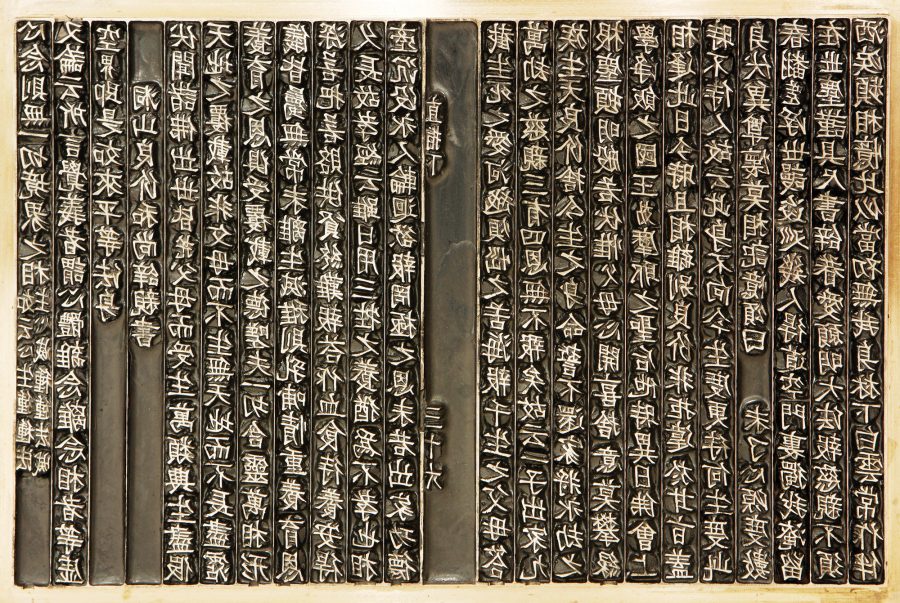
The oldest extant text ever printed with movable type predates Gutenberg himself (born in 1400) by 23 years, and predates the printing of his Bible by 77 years. It is the Jikji, printed in Korea, a collection of Buddhist teachings by Seon master Baegun and printed in movable type by his students Seok-chan and Daijam in 1377. (Seon is a Korean form of Chan or Zen Buddhism.) Only the second volume of the printing has survived, and you can see several images from it here. Impressive as this may be, the Jikji does not have the honor of being the first book printed with movable type, only the oldest surviving example.
The technology could go back two centuries earlier. Margaret Davis nods to this history, Newman concedes, writing that “movable type was an 11th century Chinese invention, refined in Korea in 1230, before meeting conditions in Europe that would allow it to flourish.” This is more than most popular accounts of the printed word say on the matter, but it’s still an inaccurate and highly cursory summary of the evidence. Newman herself says quite a lot more.
In essays at Lithub and Tricycle, she describes how printing techniques developed in Asia and were taken up in Korea in the 1200s by the Goryeo dynasty, who commissioned a printer named Choe Yun-ui to reconstruct a woodblock print of the massive collection of ancient Buddhist texts called the Tipitaka after the Mongols burned the only Korean copy. By casting “individual characters in metal” and arranging them in a frame—the same process Gutenberg used—he was able to complete the project by 1250, 200 years before Gutenberg’s press. This text, however, did not survive, nor did the countless number of others printed when the technology spread across the Mongol empire on the Silk Road and took root with the Muslim Uyghurs.
Extract — continue reading at the source.